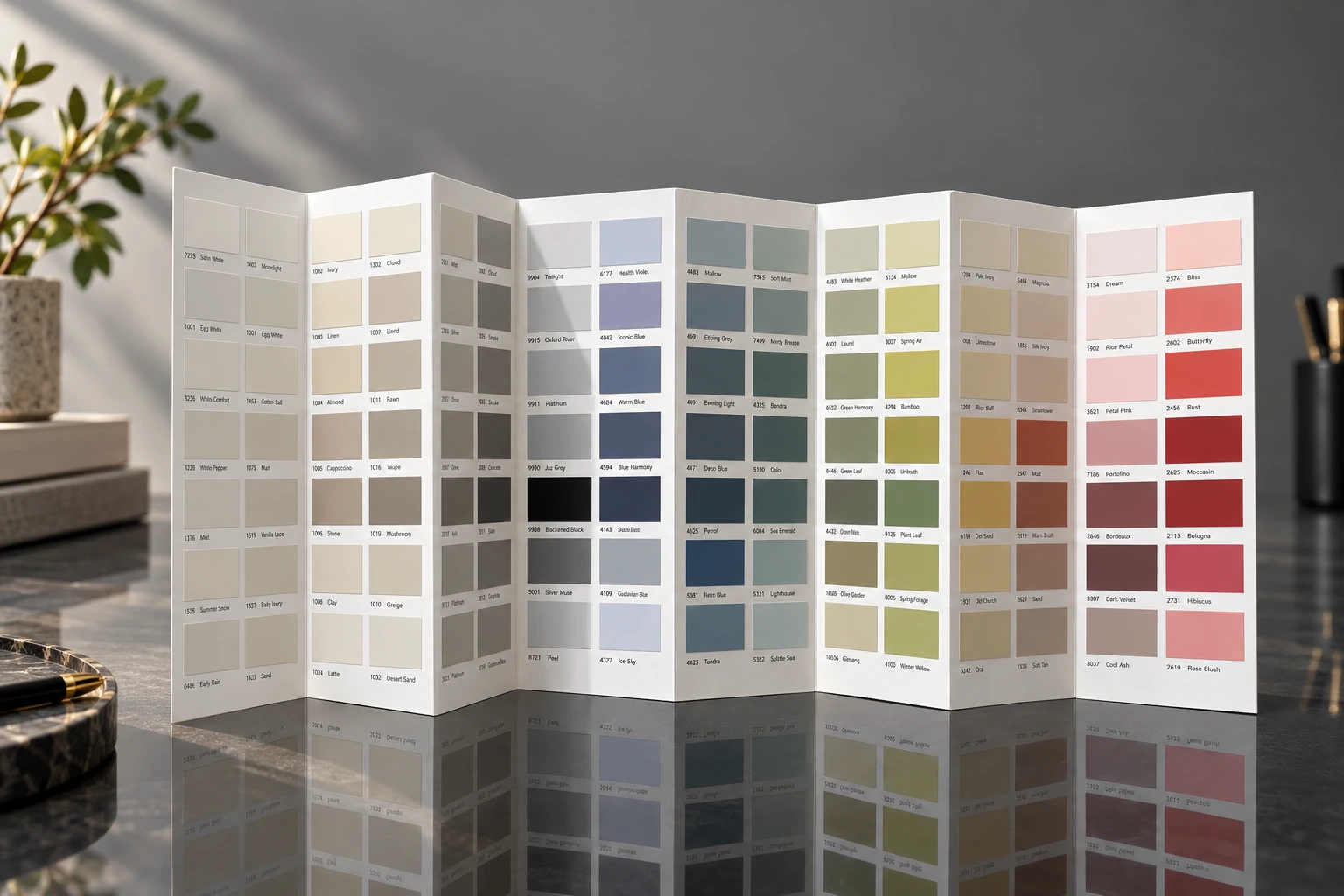
Define the Target
Confirm the approved color and finish reference, sample format and intended use.

Reliable color sample programs begin with a clear target, suitable viewing conditions and quality criteria designed around the finish and final sample format.
Technical content by PHOENiX Sample · Updated October 2026
Relevant technical references: ISO/CIE 11664-6:2022 — CIEDE2000. Reference links provide context only and do not imply certification or conformity.
Color is more than a name, code or screen preview. In a professional color sample program, the target appearance must be understood in the context of the approved physical reference, surface finish, lighting and intended application. A difference in sheen, substrate or texture can change how closely two samples appear to match—even when their numeric color values are similar.
At PHOENiX Sample, color quality is considered throughout the development of professional fan decks, color cards and coated sample formats. The goal is to translate an agreed customer reference into a well-presented, assessable sample collection, using acceptance criteria appropriate to the project.
A physical master, customer-approved sample or clearly defined color specification helps establish what the finished sample is expected to represent. The reference should identify the target shade, finish and any relevant substrate or surface characteristics.
A digital RGB image on its own is generally unsuitable as a production color standard, because its appearance can vary with displays, brightness and profiles.

Accurate communication means assessing the complete visual experience of the surface, not a single numerical reading.
When appropriate, instrumental measurements may express differences using CIELAB coordinates and a specified ΔE calculation. The selected method and tolerance must be agreed for the project.
Colors that look similar under one light source may look different under another. Viewing conditions and lighting consistency matter during assessment.
Gloss level, texture and surface uniformity influence perceived color. Samples should be compared at comparable finishes and viewing geometry.
Paper or other backing, coating coverage and the dried film can influence the final appearance. These factors belong in the quality plan.

Once a reference is approved, production quality depends on managing the factors that influence the appearance of the finished sample. Depending on the project and manufacturing method, this may include review of coating preparation, application consistency, drying conditions, substrate condition and handling.
Checks can be placed at relevant stages, rather than relying on inspection only after cutting and assembly. This supports early identification of visible variations and more consistent presentation across a collection.
Specific instruments, inspection frequency, calibration protocols and acceptance limits should be recorded in the agreed manufacturing and quality plan; they are not assumed to be identical for every product.
A practical framework for specifying and verifying sample appearance across production.
Confirm the approved color and finish reference, sample format and intended use.
Agree on viewing light, instrumental method where applicable, and project-specific acceptance criteria.
Review coated trials for visual match, gloss, film appearance and substrate effects.
Document the approved target or master against which subsequent production will be assessed.
Inspect relevant production stages according to the agreed quality approach.
Check the final appearance, sequence, physical condition and presentation quality of assembled samples.
Different formats call for different checks. A portable fan deck, mounted color card and texture catalog may share a color reference while requiring distinct presentation controls.
Delta E (ΔE) is a numerical expression of color difference calculated from measured color data using a specified color-difference formula. Different formulas—such as CIE76, CIE94, CMC and CIEDE2000—are not interchangeable, and a single number should not be interpreted without knowing the method and the evaluation context.
Useful for repeatable, defined comparisons when the measurement setup, sample geometry, lighting assumptions and formula are appropriate.
Still important for surface character, gloss, texture and overall appearance under agreed viewing conditions.
No universal ΔE tolerance is promised. Limits, measurement geometry and inspection frequency are established according to the approved project specification and capability.
A lower value indicates a smaller calculated difference under the chosen formula and conditions, but it does not describe gloss, texture or all aspects of visual appearance. The appropriate acceptance limit is application-specific.
A screen image can communicate intent, but its appearance varies by device and settings. For production approval, a physical standard or mutually agreed color specification is preferable.
Differences in spectral reflectance can cause metamerism, where samples appear to match under one illuminant but not another. This is why viewing conditions should be specified.
No. Professional sample production can use purpose-formulated coatings designed for presentation. Visual or material equivalence must be explicitly defined for the project.
An approved color reference, target finish, sample substrate or format, viewing requirements if known, quantity and any defined tolerance or inspection protocol.
Share your approved color standards, finish expectations and intended presentation format. Our team can discuss the requirements of your custom sample project.
Explore related technical topics and how they connect to color-sample manufacturing, quality, coating technology and finished fan decks.
Have a color sampling project in mind? Our team is ready to help you turn your requirements into tailored sampling and presentation solutions.
Request a Quote