


PHOENiX Sample · 4 min read · Last updated
A drawdown is valuable because it makes a coating comparison more controlled. If the application varies unpredictably, the resulting sample may reflect a difference in film build or surface preparation rather than the formulation being evaluated. A consistent trial method allows the laboratory to ask a narrower and more useful question.
The objective is not to assume that one applicator setting guarantees the same final film in every situation. It is to define and verify a preparation process appropriate to the coating and substrate.
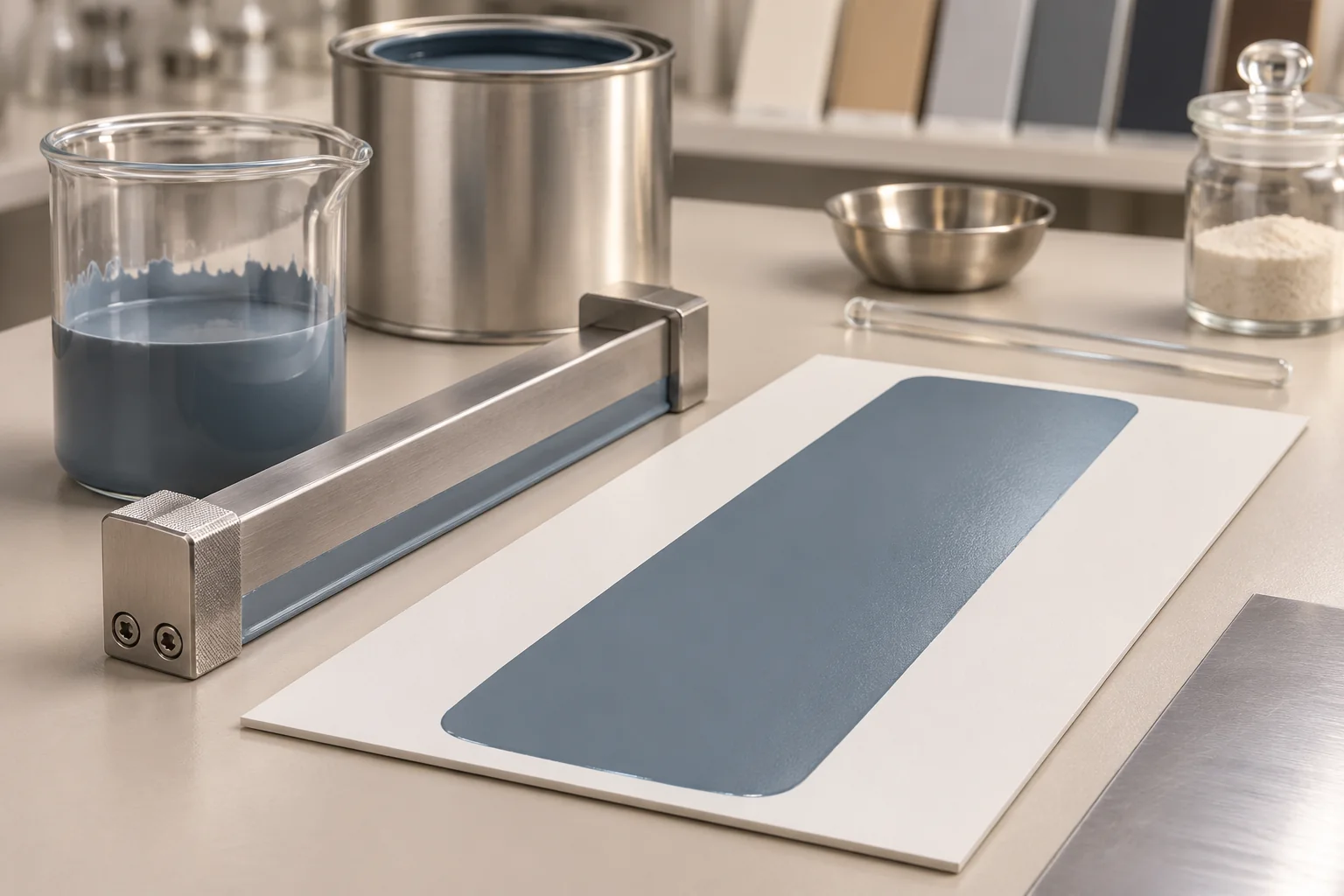
AI-generated concept illustration: A controlled paint drawdown and application tool.
Distinguish the setting from the result
An applicator gap or nominal setting describes part of the application method. It should not be treated automatically as the measured dry-film thickness. The coating's behavior, solids content, substrate and application conditions can influence the resulting film.
BYK's film-thickness guidance identifies thickness as relevant to opacity, appearance and coating properties. For color-sample development, this means that a shade comparison should be interpreted together with the application record. A difference caused by film build should not be mistaken immediately for a colorant problem. [1]
A useful planning estimate is dry-film thickness ≈ wet-film thickness × solids by volume as a fraction. For example, a measured 100 μm wet film at 40% volume solids suggests about 40 μm dry film under the simplifying assumptions of the calculation. Use the solids content of the material as applied, including any permitted dilution. The applicator gap is not a substitute for measured wet-film thickness, and the estimate does not replace verification on the actual substrate. [2]
Control the preparation sequence
Prepare the coating according to its technical requirements and use a clean, suitable applicator and support. Record the relevant process conditions and identify the trial. Keep the application method consistent across the master comparison and the candidate where the test requires it.
Do not add an unrecorded adjustment merely to make one trial look more uniform. If a change is needed, treat it as a new condition and keep the earlier result identifiable. Otherwise, the trial history becomes difficult to interpret and successful results may be impossible to reproduce.
Choose measurements that suit the specimen
Where film thickness is part of the acceptance process, select a method suitable for the substrate and coating. Different measurement techniques have different requirements and limitations. A device appropriate for a coating on metal should not be assumed to work identically on coated paper.
Inspect the whole drawdown as well as the selected measurement area. Edge effects, streaks or local variation may make a reading unrepresentative. Define which region is used for color assessment and whether the application is sufficiently uniform to support that assessment.
Use a small trial matrix
| Variable under study | Keep stable | Observe |
|---|---|---|
| Application condition | Coating and substrate | Film continuity and appearance |
| Substrate candidate | Coating and method | Surface interaction and hiding |
| Formulation candidate | Support and preparation | Color and finish after conditioning |
The matrix helps prevent several changes from being introduced simultaneously. It also makes a failed trial useful because the observation can be connected to a specific condition.
Interpret the result after the agreed conditioning
A fresh film and a conditioned film should not be compared as if they represent the same stage. Define when appearance is evaluated and how the sample is stored before review. Keep the preparation date and relevant timing with the trial record.
Understanding the illustration
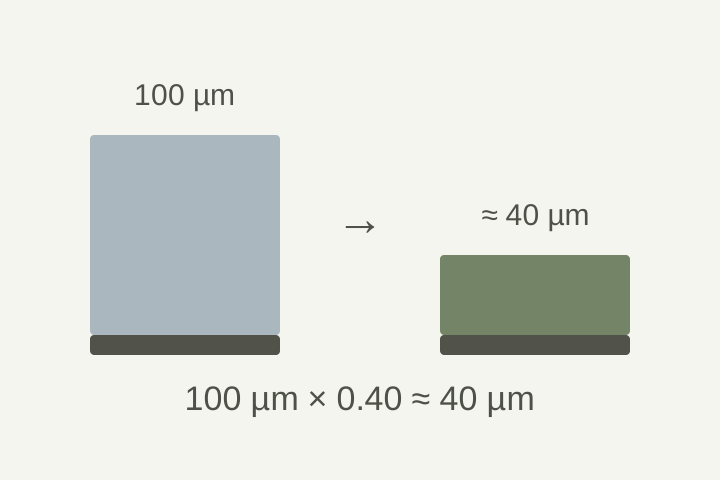
Original educational diagram: PHOENiX Sample.
Set a wet-film trial target
For a target dry film of 48 µm and a ready-to-apply coating at 40% solids by volume, start with an estimated wet film of 120 µm (48 ÷ 0.40). Use the volume solids of the actual mix after thinning. Measure the applied wet film on a suitable trial specimen, then verify the dry film after the specified conditioning. Record both measurements and the applicator setting separately. [2]
Practical conclusion
An effective drawdown procedure turns a visual impression into traceable evidence. It allows the team to distinguish a formulation question from an application question and provides a practical bridge between laboratory development and a controlled production sample.