


PHOENiX Sample · 3 min read · Last updated
The substrate is not a passive carrier beneath a color. Its surface, absorbency, rigidity and dimensional behavior can influence how a coating is applied and how the finished sample is handled. A support that works well for a flat laboratory trial may not behave the same way after cutting, binding, shipping and repeated use.
Substrate selection should therefore connect appearance requirements with the construction of the final sampling product. It should be evaluated as part of a system rather than chosen solely by thickness or price.
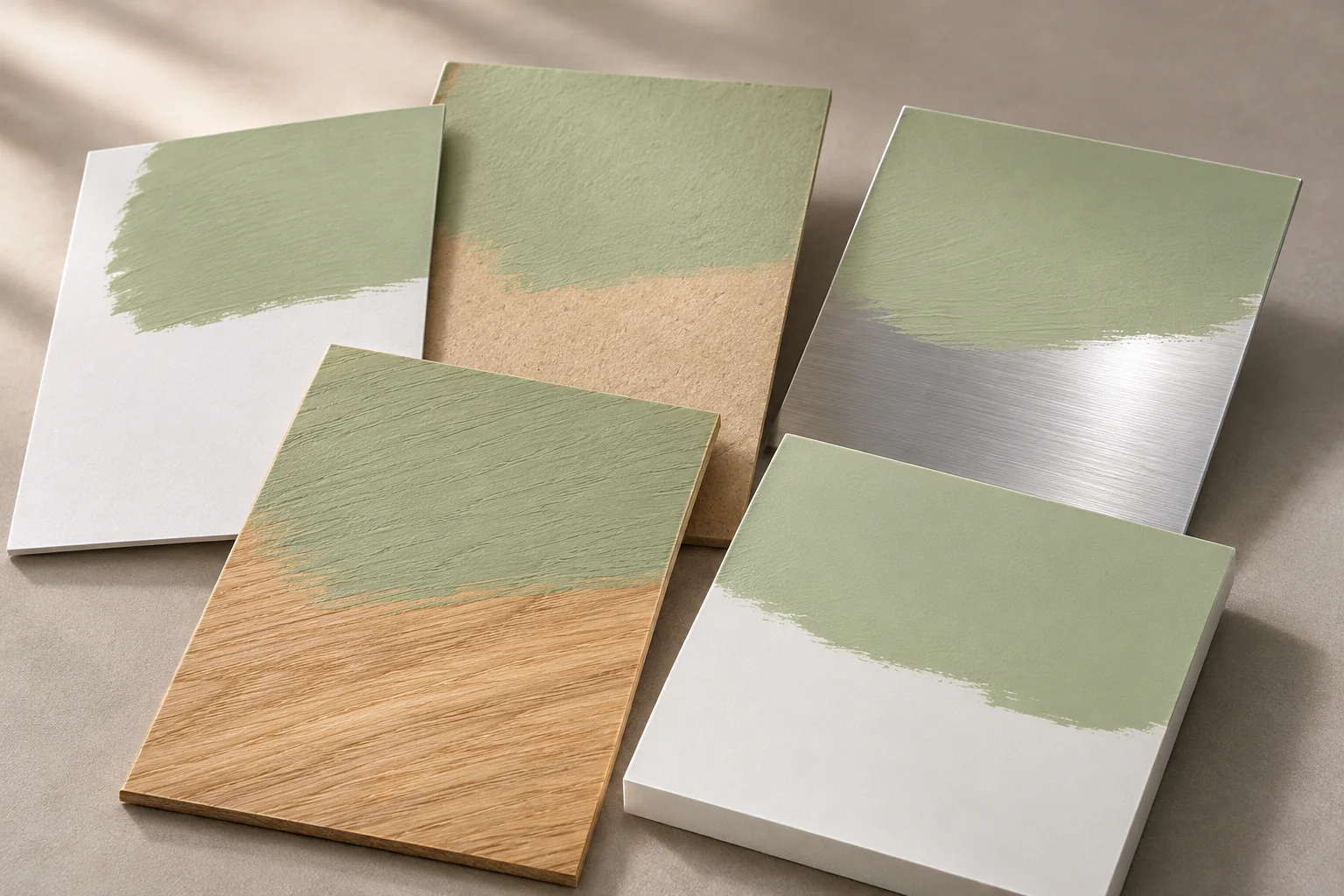
AI-generated concept illustration: Different substrate types carrying painted sample areas.
Define the coating-support relationship
Identify the intended coating and the preparation required for the candidate support. Surface treatment, sealing or priming may be part of the system. Keep these steps documented so that a later material substitution does not silently change the sample's behavior.
If the substrate contributes visibly to a translucent finish, its appearance becomes part of the reference. If the intention is an opaque color sample, assess whether the complete construction provides the required hiding. The backing and opacity principles discussed in sample-measurement guidance are relevant here, but the acceptance criteria must suit the actual product.
Compare candidates under one controlled trial
Apply the same defined process to representative substrate candidates. Record coating conditions and conditioning before evaluation. Inspect color, surface uniformity, adhesion behavior where relevant and the physical condition of the support.
Do not compare one carefully prepared sample with another made using a different application method and then attribute all differences to the substrate. A useful trial isolates the question being studied. If a candidate requires a different preparation process, record that as part of the comparison rather than treating it as an invisible adjustment.
Include converting in the evaluation
Cutting, scoring, folding, drilling and binding place demands on the sample construction. Check the actual geometry and direction of the final product. Inspect edges, folds and mounting areas for damage that may not appear in an unconverted sheet.
A fan-deck leaf needs to move around its binding point without losing its identity or damaging the coating. A mounted panel needs a suitable relationship between the coating, support and adhesive system. These requirements differ, so a substrate approved for one format should not automatically be assumed suitable for another.
Review handling and storage conditions
Consider how the samples will be transported, displayed and stored. Flatness, stiffness and surface protection affect whether the sample remains easy to use. Evaluate the finished prototype with its covers, inserts or packaging rather than assessing the support alone.
An illustrative change from one board supplier to another may preserve nominal weight while altering surface behavior. Treat the change as a controlled material revision and compare representative samples. Matching a purchasing description does not prove that the completed sample system is unchanged.
Write a specification that can survive substitutions
Record the relevant material identity, preparation, construction and acceptance observations. Define which substitutions require a new trial and who authorizes them. Avoid an unnecessarily vague requirement such as premium board when the important characteristics can be described more clearly.
Check the effect of sealing the board
Prepare two coupons from the same board lot. Seal one according to the candidate process and keep the other as supplied. Apply the same coating with the same applicator and condition both coupons together. Compare color, gloss and uniformity at equivalent positions. A difference flags the sealing step for further study. Check dry film build and surface texture before attributing it to absorption alone. Repeat on more than one board lot before changing the specification. BYK — Penetration and opacity charts
Practical conclusion
The final substrate choice should support both the intended appearance and the product's practical life. A stable sample system results from the compatibility of its parts, not from selecting the most expensive support in isolation.