
Color Brief & Reference
Confirm the color collection, approved reference standards, finish appearance, identification system and the intended market use.
Discover how purpose-developed coatings, controlled production and careful assembly bring a coordinated collection of colors together in one professional fan deck.
Technical content by PHOENiX Sample · Updated October 2026
Relevant technical references: ISO 2808:2019 — Determination of film thickness · ISO 1514:2024 — Standard panels for testing. Reference links provide context only and do not imply certification or conformity.
A professional color fan deck brings many individual color references together in a compact, easy-to-navigate format. Each shade appears on its own separate leaf, with the leaves stacked and secured at a common pivot point. They spread into a fan shape when opened; the sheets themselves are not accordion-folded, pleated or zigzag-shaped.
At PHOENiX Sample, fan-deck manufacturing is approached as an integrated color-sampling and converting project: the visual target, specialized coating, sheet construction, finishing and sequence all influence the final presentation.
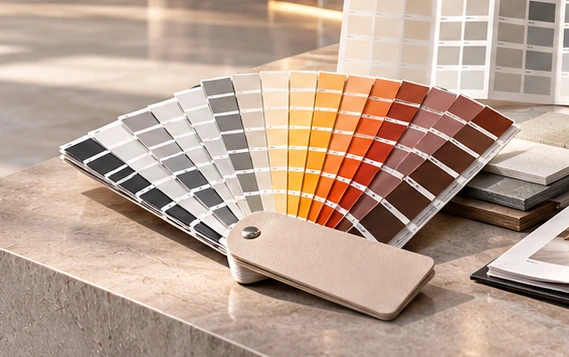
Unlike a folded brochure, a fan deck is a collection of separate, regularly shaped sample leaves. Each leaf can represent one specified color or finish, depending on the approved product design.
Leaf dimensions, corner geometry, hole position, color sequence, backing, cover materials and pivot hardware work together to determine how the deck looks, opens and withstands normal handling.
Actual production steps are tailored to the approved specification, substrate and selected coating system.
Confirm the color collection, approved reference standards, finish appearance, identification system and the intended market use.
Define the sheet stock, dimensions, layout, edge shape and practical requirements for repeated opening and handling.
Select a coating system formulated for professional color sample production. It need not be chemically identical to the customer's final decorative or industrial paint.
Apply and dry the coating under suitable process conditions, evaluating film appearance, uniformity and readiness for converting.
Compare representative finished samples with the agreed reference, including color and sheen or surface effects where specified.
Convert finished stock into separate leaves, add agreed markings or color identifiers, and arrange the collection in the correct sequence.
Assemble the leaves and cover at a common pivot, then check order, alignment, appearance, function and packaging.

The color-bearing layer is produced with a coating system specifically intended for color sampling applications. Its selection considers color appearance, suitable film formation, compatibility with the chosen sheet and subsequent cutting and assembly.
A purpose-developed sample coating may differ in formulation from the product a consumer eventually applies to a wall or another surface. The sample is developed to represent the agreed visual target, not automatically to duplicate every service-performance property of the final coating.
Controlling the coating and drying stages supports a consistent appearance across a coordinated set of sample leaves.
Once the sheets are ready, they are converted into accurately sized individual leaves. The selected arrangement might follow color families, lightness progression, product codes or a client-defined sequence.
The binding hardware must hold the leaves securely while allowing them to rotate into a fan shape. A cover can protect the stack and present the brand without making the product unnecessarily bulky.
Well-planned cutting and pivot placement reduce uneven edges, misalignment and avoidable interference when customers browse the deck.

Options are reviewed for technical feasibility and confirmed during project specification.
Shade selection, naming conventions, numbering and the order in which colors appear.
Overall deck format, leaf size, corners and the relationship between the cover and inner leaves.
Specified sample appearance, appropriate substrate and compatible coating construction.
Cover design, product identity, printed information and the chosen visual style.
Common pivot positioning, handling characteristics and the way the set opens.
Protection, labeling and project-specific packing requirements for distribution.

A professional fan deck must communicate a coordinated color range clearly. Reliable evaluation depends on the approved reference, the finished coating, defined viewing conditions and the consistency of the leaves as a collection.
Checks can include shade, sheen, surface defects, legibility of identification, sequence accuracy and the mechanical function of the completed deck. Acceptance limits are agreed for each project rather than assumed to be universally identical.
No. Each color is presented on a separate leaf. The individual leaves are stacked and joined at a common pivot, allowing them to spread out into a fan when opened.
Not necessarily. Professional samples can use purpose-developed coatings formulated for color sample production. These are selected for the substrate, coating workflow and agreed visual appearance, rather than simply using a standard finished wall-paint formula.
Finished samples are compared with an approved reference using suitable visual checks and, when specified, instrumental color measurement under defined conditions. The applicable tolerances must be agreed for the project.
Yes, a project brief can include branding, leaf identification, printed information, color organization and cover design, subject to approval of the final specification.
No. A sample is intended for agreed color and finish communication. Matching the final product's chemical formulation, durability or application performance is a separate technical requirement and should not be assumed.
Share the target color collection, intended use, preferred leaf size, approximate number of leaves, desired finish, expected quantity, branding artwork and destination. An approved physical reference helps define appearance requirements.
Explore related technical topics and how they connect to color-sample manufacturing, quality, coating technology and finished fan decks.
Discuss sample coatings, leaf format, color sequencing, branding and production requirements with PHOENiX Sample.
Have a color sampling project in mind? Our team is ready to help you turn your requirements into tailored sampling and presentation solutions.
Request a Quote