


PHOENiX Sample · 3 min read · Last updated
A decorative finish catalog needs to communicate more than a color family. Relief, sheen, directional application and variation can determine whether the finish suits a project. A small flat reproduction may introduce the collection attractively while omitting the characteristics that matter most at the point of selection.
The design challenge is to identify which properties can be represented within the catalog and which require a larger panel, a movable sample or an application mock-up.
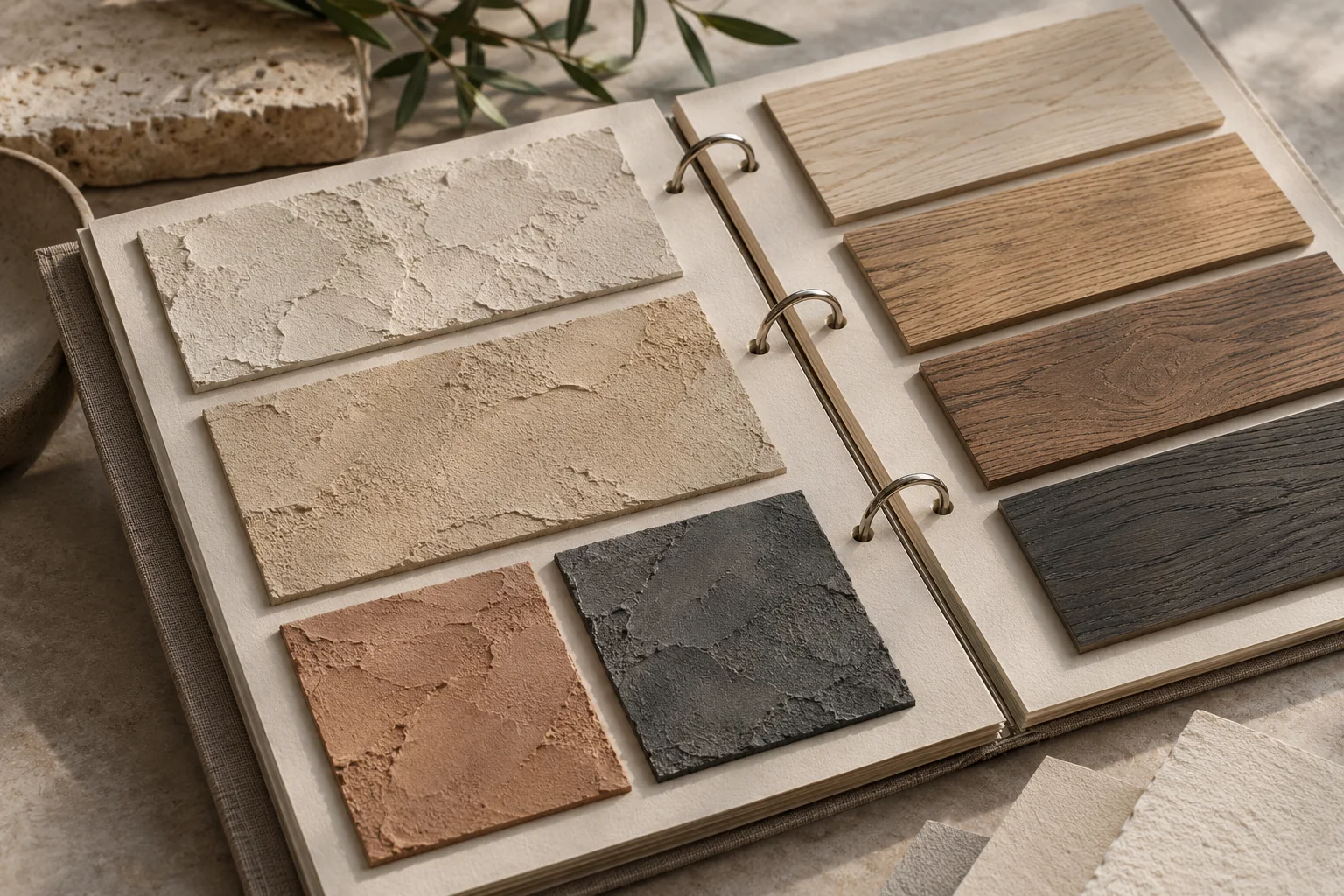
AI-generated concept illustration: A sample binder containing textured and wood-finish panels.
Define the appearance attributes first
List the features that distinguish the finish: fine or coarse texture, visible tool marks, directional reflection, transparency, particle effects or variation between areas. The catalog should make the important attributes observable instead of presenting every finish in an identical window by default.
For metallic and pearlescent surfaces, angle-dependent appearance may be central. BYK's discussion of effect finishes shows why color and effect characteristics need separate attention. A catalog that fixes every sample flat against a page can restrict the viewing movement required to understand those characteristics. [1]
Select the sample area around the pattern
A fine, relatively uniform texture may be legible in a smaller area than a finish with broad movement or large pattern variation. Evaluate actual samples at the proposed size. Do not infer suitability from a large master panel viewed at a distance.
If the catalog shows only a representative fragment, explain that role through clear product information. A single fragment should not imply that every square meter of a decorative application will repeat the same marks. Where variation is intentional, show its range in a controlled and honest way.
Design the construction around the material
Thicker panels add weight and change how a binder opens. Brittle or abrasive surfaces may need protection from neighboring samples. Removable pieces can improve comparison but introduce the risk of loss or incorrect replacement. These tradeoffs belong in the prototype review.
Test the complete object with representative materials, including the heaviest or most textured samples. A catalog that works with paper placeholders may close poorly or damage surfaces when filled with actual finishes.
Explore catalogues for textures and special finishes for your project.
Use photographs as explanation
Photographs can show a finish at architectural scale or under useful lighting, while the physical sample provides tactile and visual evidence. Keep those roles distinct. An image should not imply that its lighting, application pattern or scale is identical to the small sample.
Getty's work on modern paint materials emphasizes their diversity of properties. For presentation design, this supports avoiding a one-format-fits-all approach. The catalog should explain the selected system rather than flattening materially different finishes into an apparently uniform set of colors. [2]
Preserve the link to application
Identify the finish, substrate and relevant application information that the sample represents. Connect the catalog selection to the next stage of approval, particularly for finishes whose appearance depends strongly on technique or site conditions.
Trial two formats for the same texture
Prepare a catalogue chip and a larger companion panel with the same substrate, coating and application direction. Compare them in diffuse and raking light. If the chip shows individual peaks but crops out the repeat, use it to identify the finish and use the larger panel to judge the full pattern. Link both specimens by the same finish and revision codes. UFGS 09 90 00 — Textured wall coating samples
Practical conclusion
An effective catalog helps the reader form an informed shortlist and understand what still needs to be tested. It becomes a reference when it communicates both the attraction of the finish and the conditions under which that appearance can be assessed meaningfully.