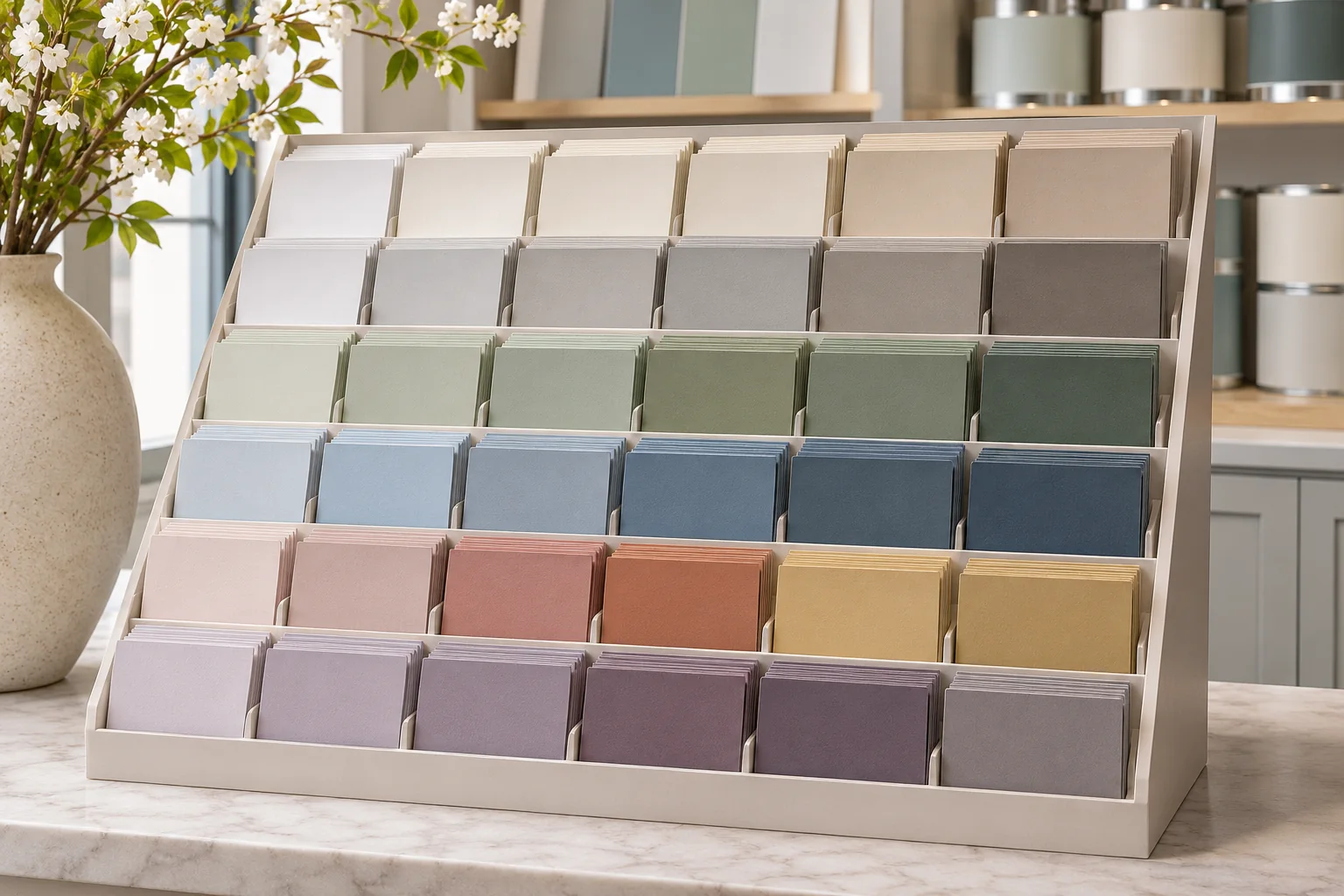



PHOENiX Sample · 4 min read · Last updated
A fan deck is a sequence of decisions as much as a stack of samples. Users move through families, compare neighboring shades and try to relocate a selection after closing the deck. An arrangement that looks orderly in a spreadsheet can still be difficult to navigate physically. The design needs to account for page movement, visible edges, labels and the way people search.
The goal is to make the collection understandable without requiring the user to learn an undocumented internal system.
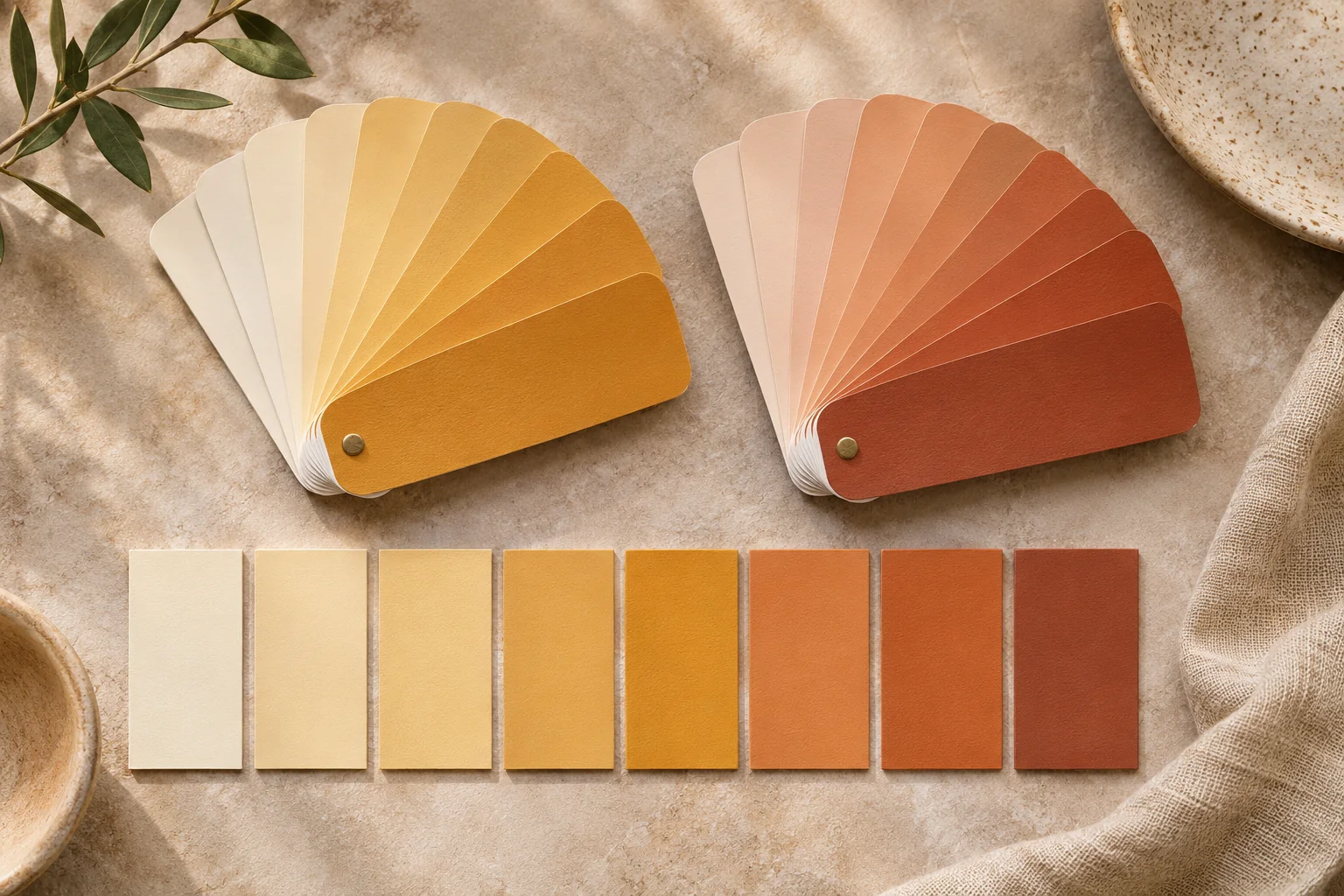
AI-generated concept illustration: Fan decks and loose chips arranged in color sequences.
Choose the organizing logic deliberately
A collection can be arranged around hue families, lightness progressions, application groups or curated stories. The chosen logic should match the intended task. A technical reference deck and an inspirational seasonal selection may need different structures.
State the rule and examine its exceptions. If a muted green belongs between gray and green families, decide where a user is most likely to look for it. Avoid repeatedly changing the logic because individual pages look attractive in isolation. Predictability is part of usability.
Munsell provides another example of perceptual organization: hue, value and chroma form distinct dimensions for arranging colors. These dimensions help distinguish a change in hue from a change in lightness or chroma. [2]
Test transitions as carefully as individual pages
The boundary between families is often where navigation becomes difficult. Lay out the full sequence and inspect the transition from one group to the next. Then review the same sequence in the bound prototype, where only part of the collection is visible at once.
A perceptual color system can inform the organization, but a custom commercial sequence should not imply equivalence to a proprietary notation system unless that relationship is genuine and authorized. ASTM D1535 describes the Munsell system, which orders colors by hue, lightness and chroma. [1]
Give identifiers a stable physical location
Place codes and names where they remain readable during normal handling. Keep their hierarchy consistent across pages and avoid positioning essential information so close to the pivot that it disappears when the deck is opened.
A user should be able to identify a shade without depending solely on its position in the sequence. If pages are removed, replaced or photographed individually, the identifier should remain connected to the sample. This also supports communication with people who perceive close colors differently.
Prototype common retrieval tasks
Use a representative prototype to test three tasks: finding a known code, exploring alternatives near a selected shade and returning to a previously viewed page. Observe the number of unnecessary movements and the points where the user loses orientation.
An illustrative test might show that a collection's pale neutrals are distributed across several families. That can be appropriate if hue is the primary organizing logic, but users may need a clear index or a complementary neutral overview. The solution should address the search behavior rather than duplicating pages without a plan.
Design for future editions
Reserve a strategy for additions, retirements and renamed shades. Inserting a new page can disturb sequence, pagination and indexing. Reusing an old code for a new shade creates a more serious continuity problem because earlier records may still circulate.
Explore custom color fan deck formats for your project.
Test a color sequence without changing identifiers
Build two prototypes with the same chips and permanent codes. Group one by hue, then by lightness within each group. Keep the other in the current order. Give users a neutral shade near a group boundary and ask them to find its nearest lighter neighbor. Record wrong turns between groups and check that both versions still lead to the same order code. [1]
Practical conclusion
Keep edition information visible and maintain a controlled mapping between codes, names and references. A deck becomes a dependable tool when its organization supports both first-time exploration and repeated professional use. The sequence should help users understand the collection while the identifiers preserve precision beyond the physical order.