


PHOENiX Sample · 5 min read · Last updated
Egyptian blue is more than an evocative name for a paint shade. In the history of materials, it refers to a manufactured pigment whose blue crystalline component is calcium copper silicate, CaCuSi4O10, associated with the mineral cuprorivaite. Its identity is a matter of composition, not simply visual resemblance. A modern coating called “Egyptian Blue” does not necessarily contain that pigment. [1]
That distinction makes the subject useful to designers, color specialists and anyone developing a historically informed palette: material identity, surviving appearance and contemporary interpretation are three different kinds of evidence.
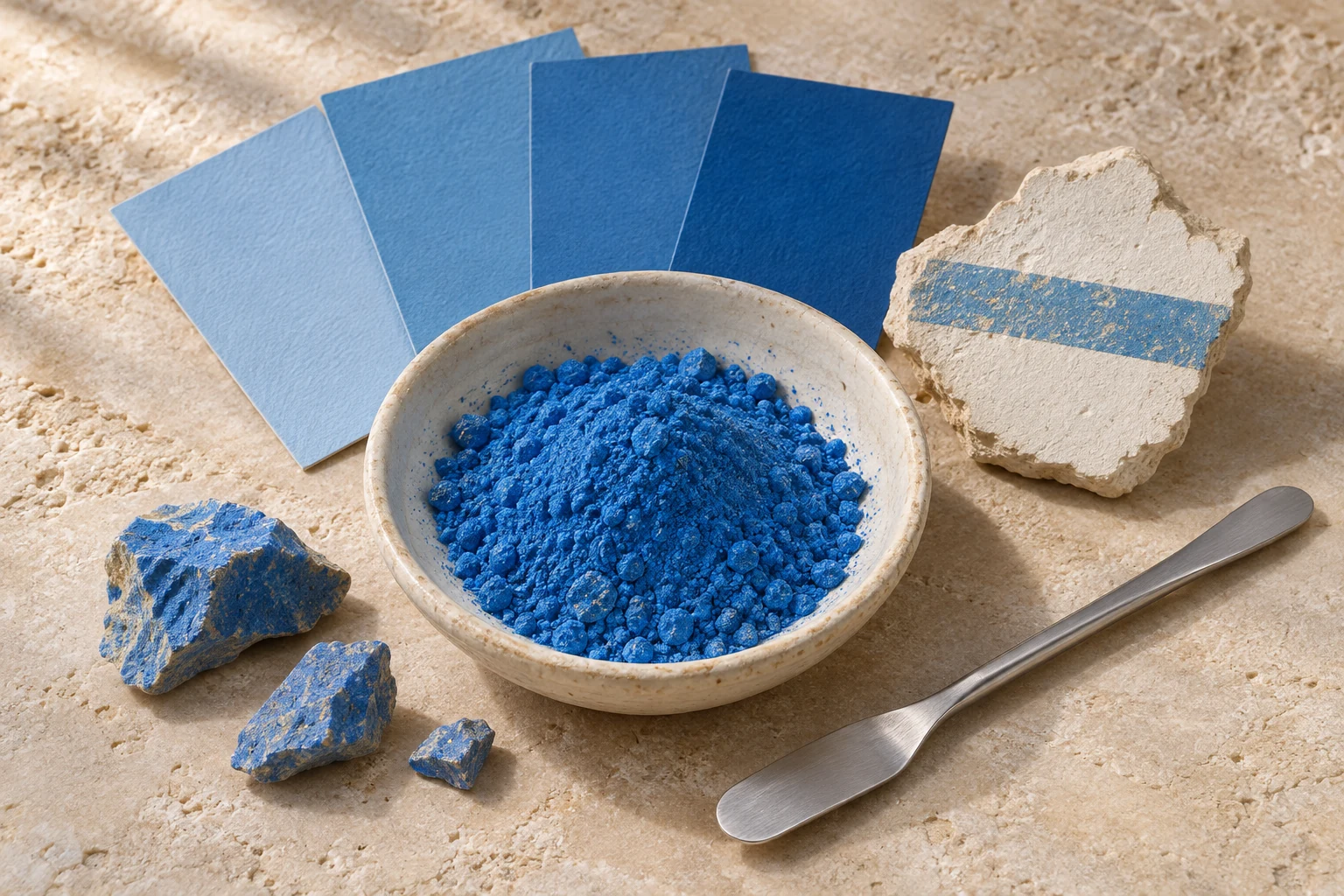
AI-generated concept illustration: Conceptual material study with blue pigment, frit fragments and painted reference cards.
A manufactured color with a long history
Egyptian blue is widely recognized as one of the earliest known synthetic pigments. Getty’s study of Romano-Egyptian portraits traces evidence to early Egyptian history and describes its later circulation around the Mediterranean. It was not confined to one dynasty or one type of object. Its production, trade and use developed across different places and periods. [2]
The portrait evidence also challenges the assumption that a blue pigment must have been reserved for visibly blue areas. Researchers have identified Egyptian blue in mixtures used for skin, hair and garments. A material can contribute to the handling of light and shade without dominating the final hue. This is a more informative account of ancient practice than treating every surviving blue surface as an isolated symbolic color. [2]
What the material actually contains
Manufacture involves heating silica with calcium and copper sources, commonly with an alkali flux. The process creates a fired material rather than merely mixing together pre-existing blue powders. Historical pigment samples can contain several phases, including residual materials alongside cuprorivaite. A 2020 study of samples from Deir el-Medina statuettes demonstrated such variation using complementary analytical methods. [3]
It is therefore misleading to imagine every ancient batch as a chemically pure, identical blue. The CAMEO materials database describes coarse, irregular particles and a range of appearances from powdery to deeper blue. Grain size and the way a material is prepared matter to its visible result. [1]
For a contemporary sample program, this suggests a practical rule: a pigment name alone is an incomplete specification. Record the actual product, substrate, binder system, application and finish represented by the approved sample. These records define the target that another team must reproduce.
The infrared signal that the eye cannot see
Cuprorivaite has a notable optical property: under suitable excitation, it emits near-infrared light with an emission maximum around 910 nanometers. This has been investigated quantitatively in materials research. The emission is outside ordinary human vision; it is not a visible blue glow or proof that an ancient wall would shine in darkness. [4]
Visible-induced luminescence imaging uses appropriate illumination, filters and an infrared-sensitive camera to map this response. Verri’s research demonstrated the technique on Egyptian blue and related historical pigments. It can reveal distributions that ordinary color photography does not show, but it requires a controlled imaging setup. A phone photograph or an RGB value cannot replace that analysis. [5]
Composition and appearance answer different questions. A material can be identified analytically even where its visible contribution is subtle. Conversely, a convincing visual color match does not establish that two paints contain the same pigment.
Three meanings that should remain separate
| Term in a brief | What it establishes | What still needs evidence |
|---|---|---|
| Egyptian blue pigment | A claim about the coloring material | Material identification and product documentation |
| Surviving historical blue | The present appearance of a particular object or surface | Condition, provenance and the relationship to its original appearance |
| Egyptian-blue-inspired shade | A contemporary design interpretation | An approved physical sample and a reproducible specification |
This framework prevents a compelling historical story from becoming an unsupported technical claim. A product may legitimately draw inspiration from an ancient palette while using a completely different modern colorant system.
There is no single historical HEX value
Assigning one digital code to Egyptian blue can be useful for a particular graphic project, but it cannot define every historical specimen. Any such code should be presented as the chosen digital representation of a specific reference, not as a universal archaeological measurement.
Begin by identifying what you are matching: a documented pigment sample, a particular surviving surface, or a new design interpretation. Prepare physical samples on the intended substrate and in the intended finish. Review them under the lighting relevant to the application. If measurements support approval, preserve the instrument settings and evaluation conditions with the results.
For a palette inspired by Egyptian blue, warm limestone, chalky neutrals or muted earth colors can provide useful starting points for comparison. These are contemporary design suggestions, not a reconstruction of one ancient scheme. Test their relationships together: the same blue may read differently beside a pale ground, a warm ochre or a dark surrounding color.
Use the history precisely
A useful project description might read: “A contemporary mineral-blue palette inspired by Egyptian color-making traditions; approved against physical sample EB-01.” It communicates the inspiration while leaving no ambiguity about the production target. A claim that the coating actually contains Egyptian blue requires separate material evidence.
Read a luminescence image beside the visible photograph
Compare corresponding areas in the visible photograph and the visible-induced infrared luminescence image. A bright spot in the infrared image can reveal Egyptian-blue particles in an area that looks dark or muted to the eye. Mark the location and consult the analytical record for pigment identification. Image intensity alone cannot reconstruct the original shade. Getty — Egyptian blue in mummy portraits
Practical conclusion
The enduring value of this pigment lies in the connection between craft, chemistry and visual judgment. Understanding that connection allows historical research to enrich modern color work without confusing a narrative, a material and a measurable sample.
References and further reading
- Museum of Fine Arts, Boston — CAMEO: Egyptian blue
- Getty — Egyptian Blue in Romano-Egyptian Mummy Portraits
- Seymour et al. (2020) — On the production of ancient Egyptian blue, PLOS ONE
- Accorsi et al. (2009) — Near-infrared luminescence of cuprorivaite, Chemical Communications
- Verri (2009) — Photo-induced luminescence digital imaging, Analytical and Bioanalytical Chemistry