

PHOENiX Sample · 5 min read · Last updated
The contribution of ancient Egypt to the history of color is best understood through things people made: painted surfaces, prepared pigments, glazed objects and carefully organized visual compositions. Their achievement lay in connecting material knowledge with skilled production and expressive purpose across many generations.
This history does not require a claim that Egyptians invented every color or worked in isolation. It is more compelling when specific accomplishments can be traced to objects, workshop evidence and technical research. Ancient Egypt also spans a long chronology; methods and preferences should not be collapsed into one unchanging tradition.
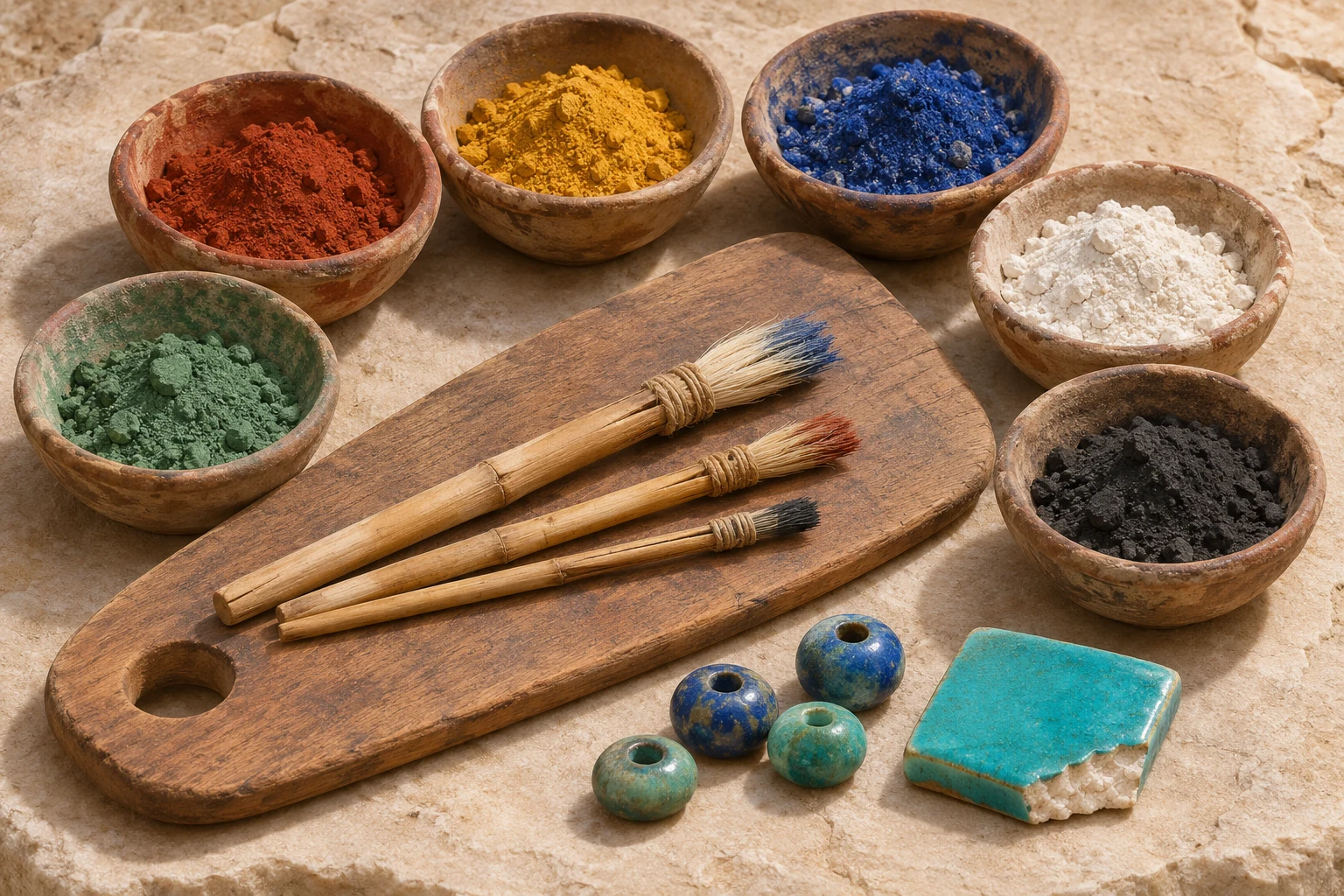
AI-generated concept illustration: Conceptual still life of pigment bowls, reed brushes and blue-green glazed beads illustrating Egyptian color-making.
Preparing color was a skilled material process
The Petrie Museum’s pigment collection, discussed by UCL, includes earth and mineral materials used to produce reds, yellows, greens, whites and blacks, alongside manufactured blue material. Its documented examples show that a palette depended on selecting, grinding and preparing substances, then making them adhere to a surface with a binding medium. [1]
That sequence involves several kinds of judgment. A craftsperson must obtain a workable material, prepare its particles, control its mixture and apply it to a suitable support. The resulting color cannot be separated from those operations. A raw mineral, a prepared paint and a finished wall are not interchangeable references.
The modern lesson is not that an ancient workshop had today’s instruments or standardized tolerances. It is that color production already required attention to the relationship between materials and process. Describing that skill precisely gives it greater substance than simply calling the colors beautiful.
Manufacturing a blue that nature did not conveniently supply
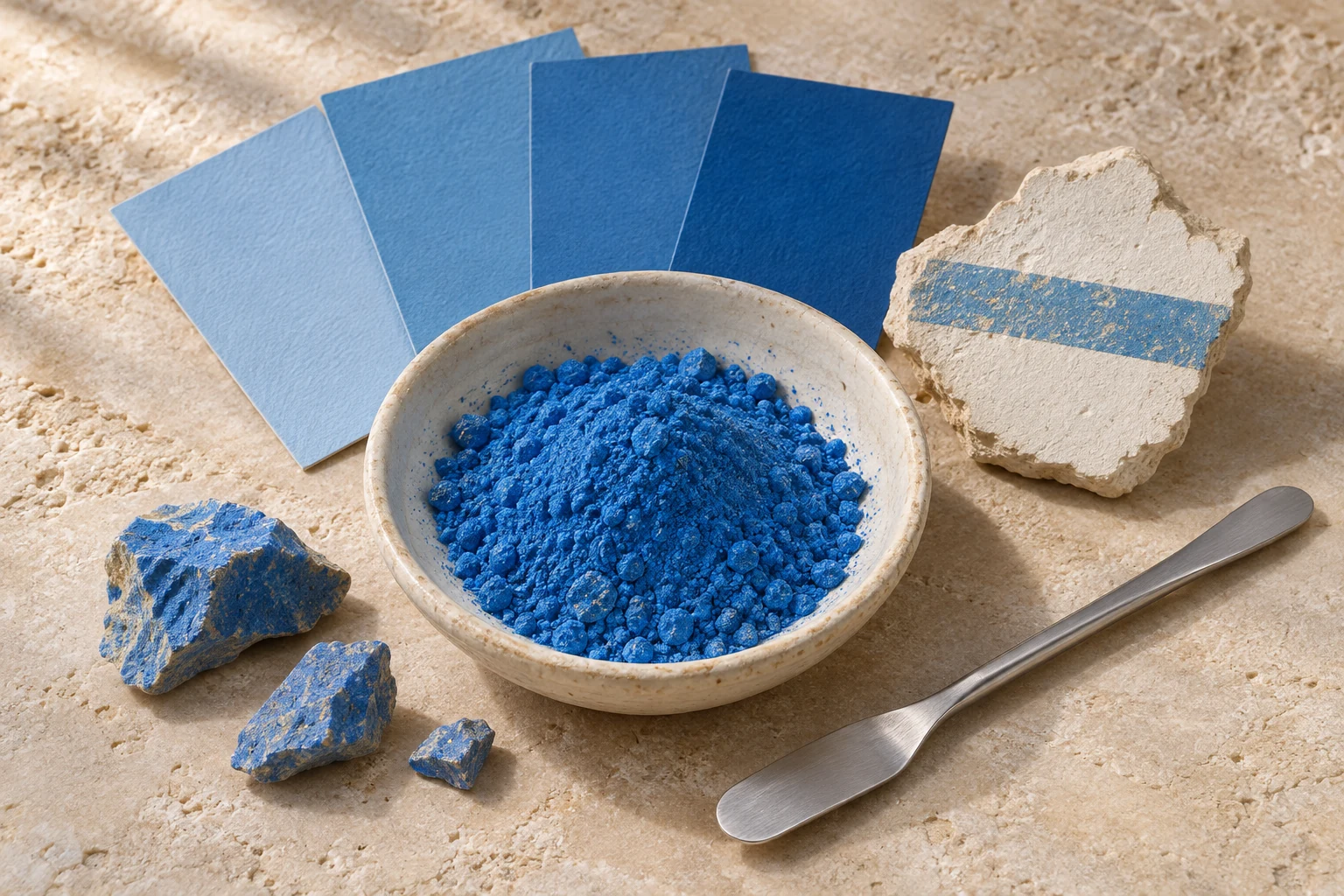
Egyptian blue provides a particularly clear example of deliberate material transformation. Instead of relying solely on a naturally blue mineral, makers used heat and selected ingredients to produce a calcium copper silicate pigment. Getty’s account places it among the oldest manufactured pigments and follows its presence in the wider history of painting materials. [2]
The significance is the controlled creation of a coloring material. Heating a mixture changes what it is, rather than only changing how finely it is ground. Our article on Egyptian blue examines that pigment in detail, including why its chemical identity is different from a modern paint name.
Faience expanded color into glazed objects
Egyptian faience is a quartz-rich glazed material, not the same thing as ordinary clay pottery or the later tin-glazed earthenware also called faience. The Metropolitan Museum describes sophisticated shaping, glazing and firing practices, including application, efflorescence and cementation methods. These routes turn relatively modest ingredients into objects with luminous colored surfaces. [3]
Blue and blue-green faience appeared in beads, vessels, figures and architectural inlays. Its brilliance carried cultural value as well as visual appeal. The Met also notes uncertainty about the material’s earliest invention outside Egypt while emphasizing the high level of refinement achieved there. Acknowledging that distinction makes the account more credible, not less appreciative. [3]
Color here belongs to a glaze and an object, not simply to a painted swatch. Gloss, curvature and surface texture contribute to the result. A matte paint inspired by a faience object can echo part of its hue while producing a substantially different visual experience.
Innovation also involved exchange
A New Kingdom glass kohl tube in the Met’s collection illustrates another dimension of this history. The museum describes Egyptian artisans adapting sophisticated polychrome glass techniques known in Mesopotamia and Syria, while glass colorants also entered faience production. This is evidence of technical exchange and creative adaptation rather than an isolated sequence of inventions. [4]
For an account of Egyptian achievement, the distinction matters. Learning from another production tradition and extending its use can be an accomplishment in its own right. A responsible history recognizes both local expertise and the movement of materials, objects and knowledge.
Color made images and spaces legible
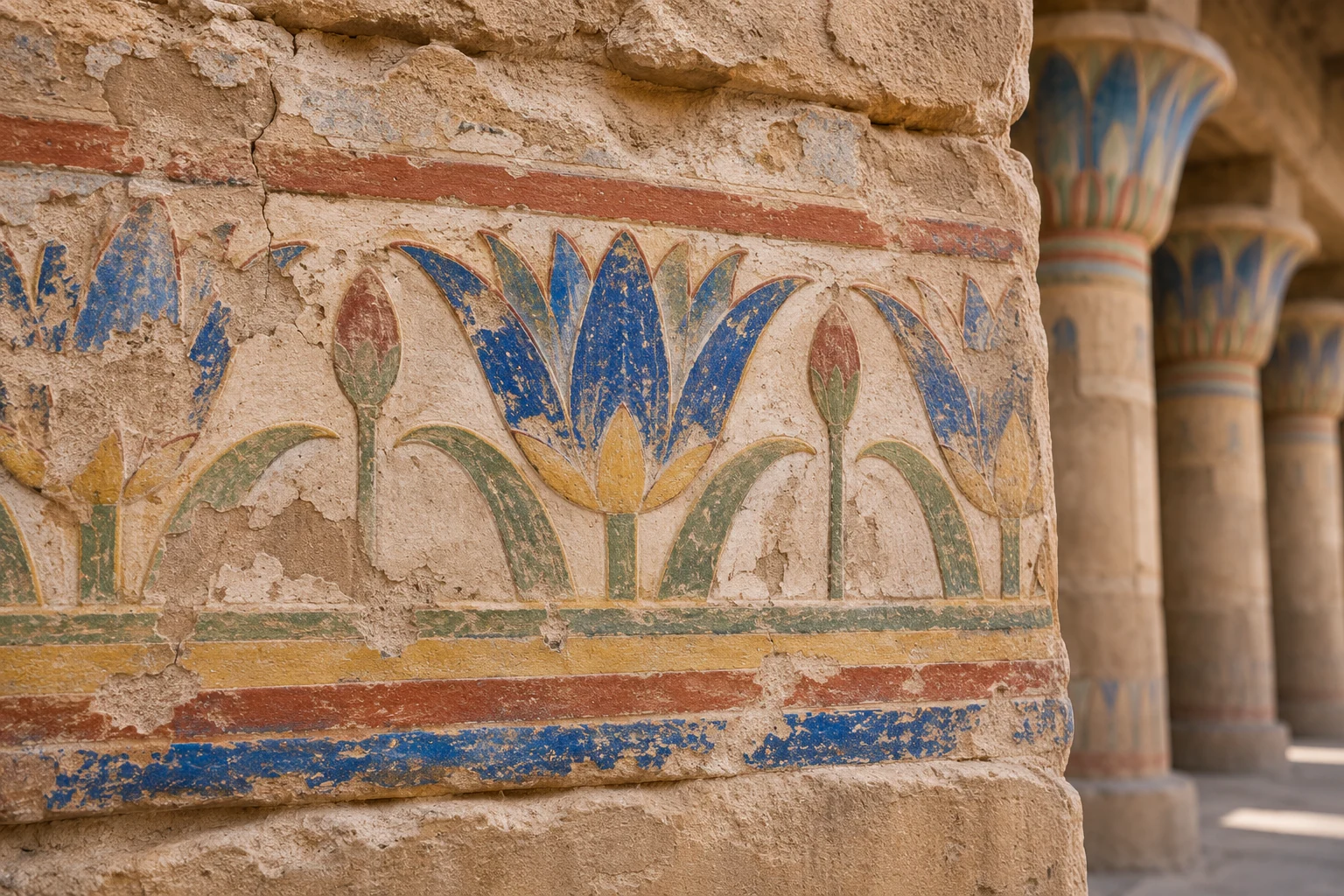
At Edfu, the University of Würzburg’s conservation project treats polychromy as evidence for iconography, decorative technique and ritual use. The project has identified details and elements present in paint as well as carving. Color was therefore part of how a decorated space communicated, rather than a dispensable finishing touch. [5]
When interpreting an ancient scheme, begin with its specific setting. The role of a blue ceiling, a white ground or a colored garment should be studied with the relevant image, text, material and period. A universal dictionary that assigns one fixed meaning to every color can erase the distinctions that make the evidence interesting.
For contemporary presentation, this suggests examining hierarchy and relationships: which areas draw attention, which provide a ground, and which separate forms or information. These are design questions that can be informed by historical work without claiming to reproduce its religious meanings.
Different achievements need different evidence
| Achievement | Evidence to examine | Useful distinction |
|---|---|---|
| Preparing a painting palette | Pigments, tools and paint-layer studies | Raw material versus applied paint |
| Manufacturing Egyptian blue | Composition and production research | Material synthesis versus color naming |
| Developing glazed color | Faience cores, glazes and firing evidence | Glazed appearance versus matte color |
| Organizing decorated spaces | Surviving paint, relief and contextual research | Documented function versus modern interpretation |
A legacy that rewards precise description
Nor does survival prove that every material was indestructible. Our article on surviving temple colors considers loss, protection and conservation separately. Together, these perspectives support an appreciation based on evidence: an influential craft tradition whose material intelligence remains worth studying today.
Compare two ways of making blue
Set a photograph of a blue faience object beside a photograph of a blue painted surface. Label the quartz-rich body and colored glaze on the faience, and the pigment-bearing paint layer on the painted object where documented. Use museum descriptions to identify the material construction before comparing the colors. The Met — Egyptian faience
Practical conclusion
Ancient Egypt’s distinction in color-making lies in the range and sophistication of these connected practices: preparing substances, transforming materials through heat, applying color with skill, and giving it a role in objects and spaces. No single surviving blue, glaze or temple wall tells that whole story.
References and further reading
- UCL Researchers in Museums — Colours of Ancient Egypt: introduction
- Gabrielle Thiboutot, Getty — Egyptian Blue in Romano-Egyptian Mummy Portraits
- Carolyn Riccardelli, The Metropolitan Museum of Art — Egyptian Faience: Technology and Production
- The Metropolitan Museum of Art — Kohl Tube in the Shape of a Papyrus Column
- University of Würzburg — Polychromy and conservation at Edfu