


PHOENiX Sample · 4 min read · Last updated
Egyptian blue, ultramarine and cobalt blue are often placed together in stories about the history of color. Their shared color family can obscure important differences. They are not three names for one substance, nor do they form a simple sequence in which each universally replaced the last. Comparing them reveals different relationships between mineral resources, manufacture and artistic use.
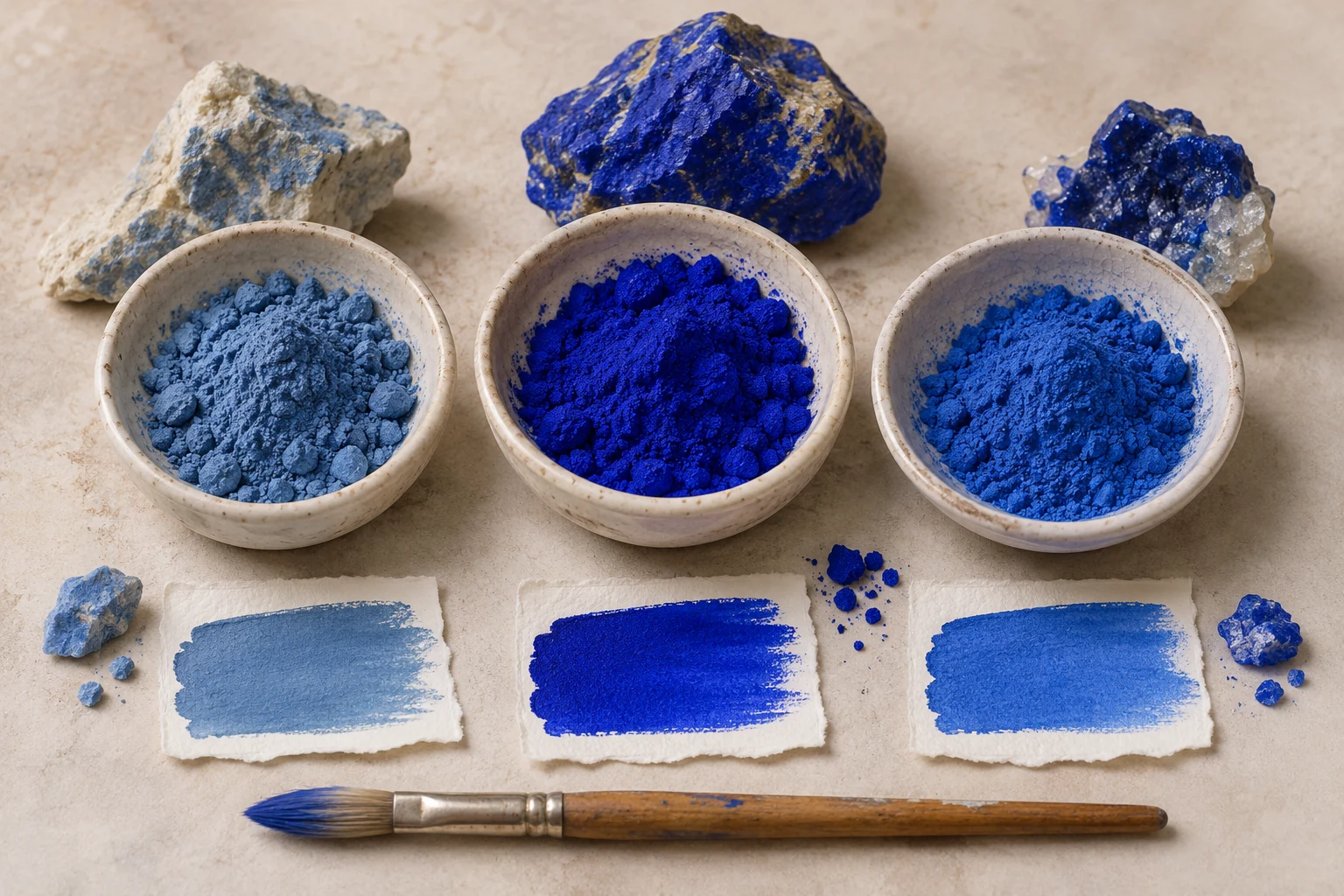
AI-generated concept illustration: Three conceptual blue pigment studies with powders and painted swatches.
Egyptian blue: a manufactured silicate pigment
Egyptian blue is a manufactured pigment associated with calcium copper silicate, or cuprorivaite. Its historical identity concerns the material and its production, not a single standardized modern shade. The CAMEO entry records its ancient use and material characteristics. [1]
For a modern designer, the key distinction is between a coating that contains the historical pigment and a coating whose name or appearance is inspired by it. A blue paint can legitimately evoke Egyptian color traditions without making a claim about its actual pigment composition.
Ultramarine: natural and synthetic histories
Natural ultramarine is prepared from the blue lazurite component of lapis lazuli. Separating that blue fraction from associated minerals required processing, and different grades could result. CAMEO describes this extraction history and the variation between fractions. [2]
Synthetic ultramarine introduced another production route. CAMEO records Guimet’s discovery in 1826 and commercial sale in 1828. [3] Natural and synthetic ultramarine should therefore be distinguished in a material history even when both are described with the same familiar color word.
Cobalt blue: identify the particular material
Cobalt blue as an artists’ pigment commonly refers to cobalt aluminate. CAMEO links its early nineteenth-century development to Thénard and distinguishes the pigment from other cobalt-related color uses. Cobalt-containing glass or glaze should not automatically be described as the same pigment preparation. [4]
This is a useful reminder that an element, a pigment and a finished colored material are different levels of description. Finding the word “cobalt” in a historical account does not by itself establish that a particular paint contains cobalt aluminate.
Compare material claims rather than digital swatches
| Name | Material distinction | Question for a modern specification |
|---|---|---|
| Egyptian blue | Manufactured calcium copper silicate pigment | Actual pigment or historical inspiration? |
| Natural ultramarine | Lazurite-rich pigment separated from lapis lazuli | Natural material documented, or a color name? |
| Synthetic ultramarine | Manufactured ultramarine pigment | Which product and approved formulation? |
| Cobalt blue | Commonly cobalt aluminate in pigment terminology | Material identity or an imitated hue? |
The table separates identities, not universal visual rankings. A photographed powder, a paint film and a digital square are different presentations. Do not use one online swatch to claim that every specimen of a pigment must be lighter, greener or more saturated than every specimen of another.
Turn the history into an honest contemporary brief
For a historically inspired collection, identify which aspect is being interpreted: material, visual character, place or story. An illustrative brief might ask for three contemporary blues inspired by the three histories, each approved against its own physical sample. That is a design project, not a reconstruction of historical recipes.
If actual pigment composition matters, request product documentation and appropriate material evidence. If only appearance matters, define the physical target, substrate and finish. Avoid borrowing the authority of a material name to imply authenticity that the brief does not require or the evidence does not establish.
Keep the comparison open to evidence
Historical color research becomes more useful when it preserves distinctions instead of compressing them into a slogan. Record the source of each material claim and avoid assuming a universal historical preference from a single object or period.
Build a comparison record for three blues
For each specimen, record the pigment identification and its evidence, the binder and substrate when known, and the viewing conditions. Record whether ultramarine is natural or synthetic only when supported. Check whether a cobalt label names cobalt aluminate or another cobalt-containing material. Keep the modern color code in a separate field with a reference to its physical chip. MFA CAMEO — Cobalt blue
Practical conclusion
These three blues offer three ways to connect color with making: manufactured ancient pigment, processed mineral and later industrial chemistry. Their value to contemporary color work is not a set of supposedly timeless HEX values. It is a clearer vocabulary for discussing origin, material identity and the approved appearance of a real surface.