



PHOENiX Sample · 4 min read · Last updated
Light reflectance value is useful when a design team needs to compare how much visible light surfaces reflect under defined conditions. It gives a different kind of information from a color name or a rendered room image. Its strongest role is as one documented input to a material decision, alongside hue, finish, lighting and the relationship between adjacent surfaces.

AI-generated concept illustration: Dark, middle-gray and light painted boards in an architectural setting.
Understand what the number represents
LRV expresses light reflectance on a scale conventionally running from theoretical black at 0 to theoretical white at 100. SATRA describes its relationship to the CIE Y value and the controlled measurement of surface reflectance. The method and specimen condition are therefore part of the result. [1]
A value is not a percentage of paint pigment, an energy-saving guarantee or a direct prediction of room brightness. Record the actual product and finish associated with the number. A similarly named shade in another material should not inherit it without supporting data.
LRV is not CIELAB L*. Both relate to lightness assessment, but they use different scales: L* is a nonlinear function of the relative Y value. Keep the quantities labeled in data sheets and do not enter L* values into an LRV comparison schedule.
Use LRV and hue for different decisions
A palette can contain distinct hues with similar LRV values. It can also contain related hues with very different values. Use hue and chromatic relationships to develop the color character, then check reflectance relationships where they matter to the design.
For example, an illustrative scheme might use a pale wall, a darker door and a still darker handrail. The purpose of comparing their declared LRV values is to understand the proposed separation. It does not establish that the completed installation meets every accessibility or visibility requirement.
Do not equate LRV with room illuminance
Room illumination depends on the light sources and the arrangement of surfaces. A high-LRV paint does not define how much light reaches a desk, and a small digital swatch cannot establish the effect of the finished room. Treat lighting calculations and on-site assessment as separate tasks.
Manufacturer LRV data can support the early material shortlist. Tikkurila describes LRV as a way to distinguish light-absorbing and light-reflecting colors. [2] For approval, obtain the value relevant to the selected finish and verify any project-specific evidence requirements.
Create a material comparison schedule
| Field | Example of what to record |
|---|---|
| Location | Corridor wall, door leaf or trim |
| Product identity | Manufacturer, product, shade and finish |
| LRV evidence | Published or measured value, source and date |
| Adjacent surface | The actual material being compared |
| Review status | Design review, mock-up review or final approval |
Use the schedule to expose missing information. If the door finish changes late in the project, reopen its comparison with the wall. A spreadsheet populated with generic shade values can hide exactly the substitution that needs attention.
Review contrast in the intended setting
Check the relevant project requirements before deciding what separation is sufficient. Different applications and jurisdictions may specify different criteria and methods. Avoid copying a single numerical rule into every paint project or presenting a subtraction as a complete compliance assessment.
Use physical samples and, where necessary, a mock-up that shows the actual junction, dimensions, lighting and finish. Record whether the intended distinction remains clear from the relevant viewpoints. Gloss and reflections should be assessed in that setting rather than inferred from LRV alone.
Preserve the decision through procurement
Attach the approved product schedule and evidence to the procurement record. Require a review when product, finish, substrate or shade changes. At handover, keep the actual installed identities with the maintenance information so a future repaint does not unintentionally alter the intended relationship.
Understanding the illustration
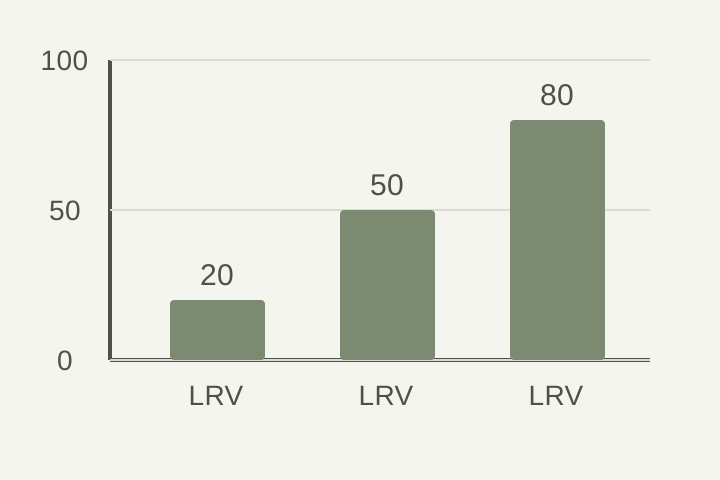
Original educational diagram: PHOENiX Sample.
Recheck material substitutions
A wall with LRV 68 and a door with LRV 38 differ by 30 LRV points. If a replacement door finish has LRV 49, the difference falls to 19 points. These are hypothetical values for a design review. Record the source for each finish and check the actual junction under the intended lighting before approving the substitution.
Practical conclusion
LRV becomes most useful when it survives this chain from selection to installation. A defensible decision states which surfaces were compared, which data were used and what still required physical assessment. That is more informative than describing a paint as simply light or dark.