


PHOENiX Sample · 4 min read · Last updated
There is no universally correct number of colors for a paint collection. A compact range can omit useful choices; a large one can make navigation harder without improving the decision. The useful question is what the collection must help its audience choose, and whether each additional shade contributes a distinct, supportable role.

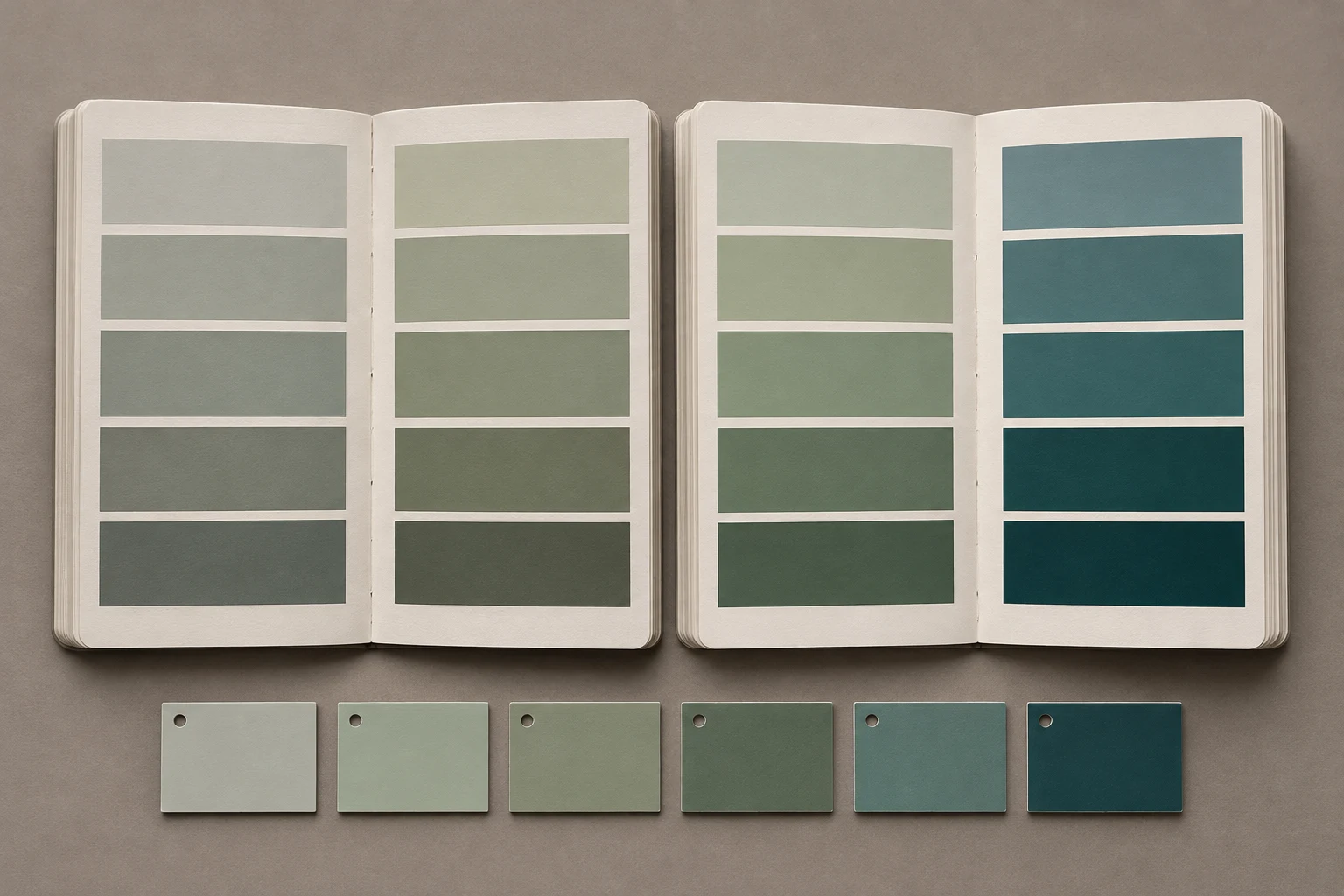
AI-generated concept illustration: Broad color grid compared with a smaller selection of physical samples.
Define the selection job
Start with the intended audience and application. A contractor choosing reliably reproducible exterior shades has different needs from a designer exploring a wide interior palette. Identify the decisions the collection should support before deciding how many leaves fit the binding.
Write a few realistic tasks: find a warmer alternative to an approved neutral, select a darker trim within a family, or identify a restrained blue for a specific material setting. These tasks make omissions and confusing duplicates visible. A collection should be evaluated as a working tool, not only as a complete-looking wall of color.
Map coverage in more than one dimension
The Munsell system organizes color by hue, value and chroma. [1] That distinction offers a useful starting framework for auditing a collection: check families, lightness steps and chromatic strength rather than counting hue labels alone.
Build a map of the actual samples and identify gaps relevant to the brief. A range may contain many greens but lack a subdued, darker option. Another may have several nearly interchangeable pale neutrals while omitting a useful middle-lightness transition. The decision to add or remove a shade should respond to such a finding.
Evaluate additions against a clear role
| Question | Evidence to examine |
|---|---|
| Does it fill a useful gap? | Physical comparisons within its family |
| Can users distinguish its role? | Selection tasks using the proposed range |
| Can it be supplied consistently? | Product availability and approved sample evidence |
| Can it be found and identified? | Navigation, coding and sequence review |
| Does it create maintenance burden? | Sampling, stock and update requirements |
Do not remove shades merely because they are close numerically. Their intended finish, product availability or market role may differ. Equally, a new name does not establish a meaningful new choice if users cannot explain or use the distinction.
Test compact and extended alternatives
Build two prototypes around the same task set. Observe whether people can reach an appropriate shortlist, identify the selected code and explain nearby alternatives. Usability testing guidance recommends realistic tasks that invite action without telling the participant how to proceed. [2]
For an illustrative exercise, compare a compact core range with an extended range containing additional nuanced neutrals. Record unresolved tasks, selection reversals and code errors. Do not assume that fewer choices must win: the extended range may solve important tasks the core range cannot.
Consider a layered collection
A core collection with a clearly identified extension can serve different levels of exploration. It needs a coherent code system and an obvious route between the two. Avoid creating an “extended” range that customers cannot actually obtain in the specified product.
Check the physical consequences as well: weight, leaf handling, display footprint, sample replacement and how a salesperson explains the structure. The right architecture may be several coordinated tools rather than one increasingly large fan deck.
Make the count an outcome
Approve the coverage map, usability findings and production feasibility together. Record why each retained group exists and which needs remain outside the range. This gives future editors a basis for change that is more durable than a target count.
Decide whether to keep an extension
In a pilot, the core deck covers seven of eight priority briefs. The extension adds three muted greens, and only one resolves the missing brief. Keep that green if it can be produced and supplied in the required finish. Retest the revised range against the same briefs and record why each addition earns its place. Nielsen Norman Group — Task scenarios
Practical conclusion
A collection is strong when its choices are useful, findable and deliverable. Its final number should reflect those qualities. Review it using observed selection problems and actual service requirements, rather than expanding it simply to claim a larger palette.