


01
Retail
Try Castle Stone on a sizeable painted panel in the retail, with natural leather nearby. Compare it against limestone before deciding whether it works as the main wall color or a smaller accent.

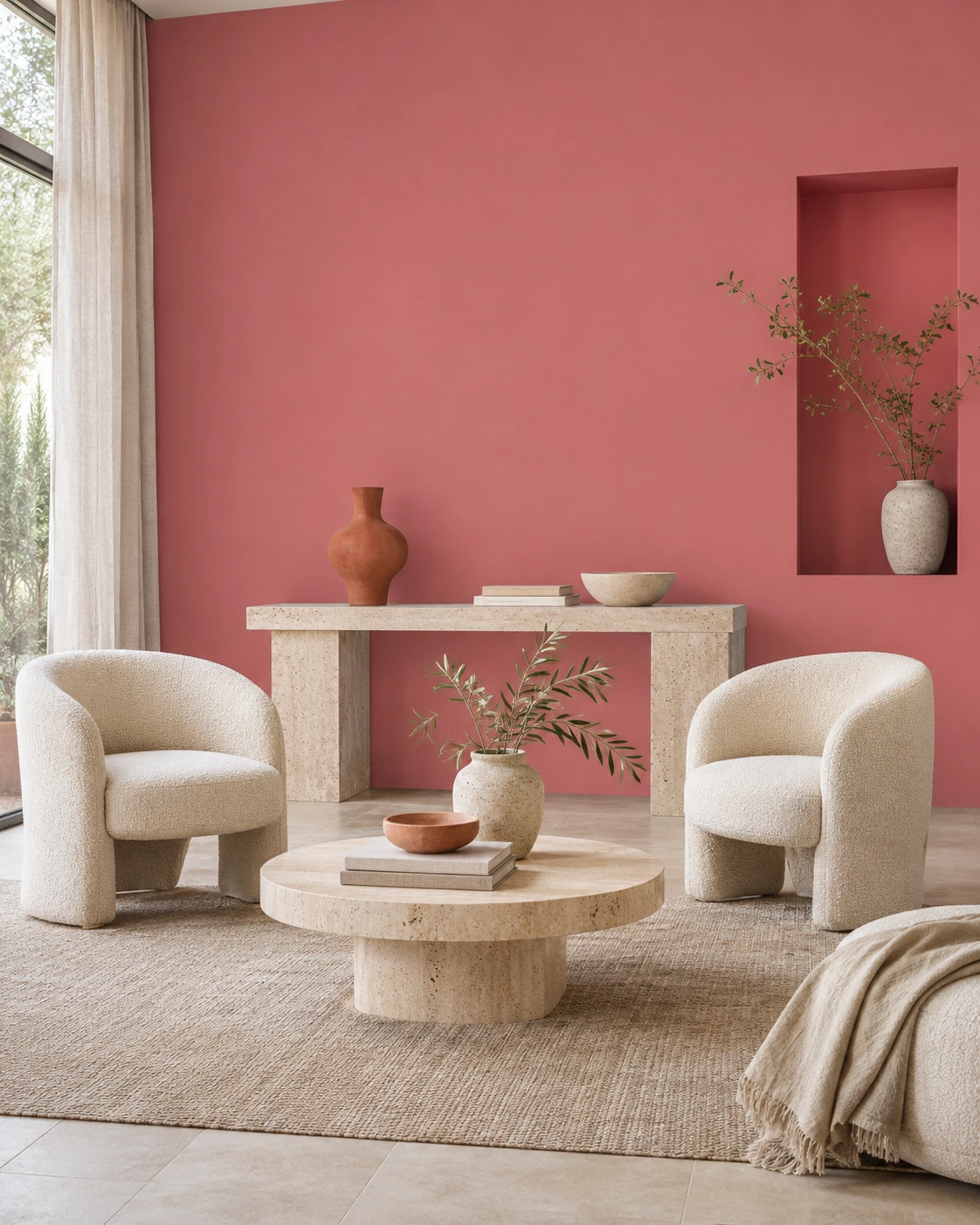
Confident clay rose for considered accents.
A confident, clay-tinted pink with muted richness. Used thoughtfully, it can add warmth, personality and an architectural focal point.
Castle Stone belongs to the Blush & Earthy Rose palette. A confident, clay-tinted pink with muted richness. Used thoughtfully, it can add warmth, personality and an architectural focal point. Its most useful design quality is its clay-pink depth next to stone; compare it with limestone and natural leather before building the rest of the scheme.
For a small reading room, introduce sand beige as a quieter companion and use dark bronze for a measured point of contrast. The aim is to test these relationships, not to treat a screen color as a paint specification.
Three ways to explore Castle Stone in a real interior. Every suggestion should be checked against the room's actual light and materials.
Try Castle Stone on a sizeable painted panel in the retail, with natural leather nearby. Compare it against limestone before deciding whether it works as the main wall color or a smaller accent.
Use sand beige on the connecting surfaces so Castle Stone has room to register. In a bedroom, test the meeting point with doors, ceiling paint and the principal flooring before finalizing the palette.
Bring in dark bronze through one movable object or fabric rather than committing every surface to contrast. Check Castle Stone in the dining under the actual lamps and available daylight.
Explore these three actual color directions from the 2026 collection. The visual relationships are editorial suggestions; compare real samples before choosing a scheme.
Assess Castle Stone on two walls that receive different light. Its defining variable is its clay-pink depth next to stone: compare the fully dried color near the window and deeper inside the room, then repeat after the evening lights are switched on. The neighboring limestone and sand beige may change how its undertone appears.
A low-sheen finish can make Castle Stone feel visually quieter beside natural leather, but a satin coating may be more suitable where cleaning is frequent. Test the selected manufacturer’s product on the actual substrate: sheen, texture and film build can affect the appearance, and the right specification depends on the room’s use.
Paint a sufficiently large sample of Castle Stone, allow it to dry according to the product instructions, and compare it directly with limestone, natural leather and sand beige. Review the result in daylight and artificial light. A printed, real-paint fan deck or color chart is useful for comparing options, but the final on-site painted sample remains essential.
PHOENiX Sample researches color directions and manufactures custom real-paint fan decks and color charts for paint and coatings manufacturers.
Explore how Castle Stone interacts with daylight, surrounding materials and coating sheen, then use a physical paint sample to verify the choice in its intended space.
Confident clay rose for considered accents. In practical terms, Castle Stone can connect natural leather with limestone without requiring every finish in the room to match. Its visual identity depends particularly on its clay-pink depth next to stone.
For a small reading room, begin with Castle Stone as the color under consideration, place sand beige beside it, and introduce dark bronze in a limited accent. Photograph the test surfaces only as a record of the arrangement: make the final judgment in person, where material texture and reflected light are visible.
When evaluating Castle Stone, pay close attention to its clay-pink depth next to stone. Observe a dried test area beside limestone in morning and late-day light; the same wall can change in apparent depth and undertone when the main source of illumination changes.
Choose matte, eggshell or satin for the coating’s service requirements rather than on appearance alone. Beside natural leather, a lower sheen may soften reflections; on a frequently handled surface, the paint manufacturer’s cleaning and durability guidance takes priority. Test the chosen sheen rather than assuming the digital image predicts it.
Castle Stone is an editorial color direction in the 2026 PHOENiX collection. This reference is not a paint formulation or an instrument-certified match. Compare a fully cured sample at the scale, lighting and sheen intended for the project.
For brands developing customer-facing color collections, PHOENiX Sample can manufacture custom fan decks and color charts with real applied paint. These physical presentation tools support comparison of actual coated samples; product approval should still follow the paint manufacturer’s own specification and quality process.
Editorial guidance only. Castle Stone is a 2026 color-trend research direction.